The terms fixed wireless internet and mobile wireless internet do sound similar—and there are similarities between the two. Both rely on the wireless transmission of the internet to connect your devices to the web.
However, these two types of connections are not the same. Fixed wireless and mobile broadband rely on different technologies to provide a different kind of broadband service for your devices. While one prioritizes portability to perform simple tasks on the go, another prioritizes fast speeds and higher data caps.
In this blog, we’ll explain what mobile wireless and fixed wireless internet are. Then, we’ll compare the two to highlight the differences in both connection methods.
Quick answer: Fixed broadband (including fixed wireless) connects one location and is typically more consistent for work-from-home, streaming, gaming, and video calls. Mobile broadband is portable and convenient on the go, but performance can vary more due to coverage, congestion, and plan limits (like data caps or throttling).
Fixed vs Mobile at a Glance
| Feature | Fixed Wireless Internet | Mobile Wireless Internet |
|---|---|---|
| Best for | Home/business at one address | Phones, hotspots, travel |
| Portability | Not portable | Highly portable |
| Consistency | Typically steadier | Can vary by location/congestion |
| Latency | Often lower | Often higher/variable |
| Data caps | Often higher (provider-dependent) | More common (provider-dependent) |
What is Mobile Wireless Internet?
For most people, mobile wireless internet is an additional service added to their cell phone service plan. It will connect cell phones and other devices on the plan to the internet.
This wireless connection is transmitted from cell towers, and the device will switch the connection from tower to tower as your internet-connected device moves from place to place. As long as you’re within the cellular network’s range of service, you should have access to the internet.
Mobile wireless internet is often used through a phone’s built-in data connection or through a dedicated mobile hotspot device that shares that cellular connection with other devices.
What is Fixed Wireless Internet?
Fixed wireless internet, on the other hand, is independent of your cell phone provider. It provides a fixed internet connection for devices within a specific area or building and is meant to serve as your primary home or business connection.
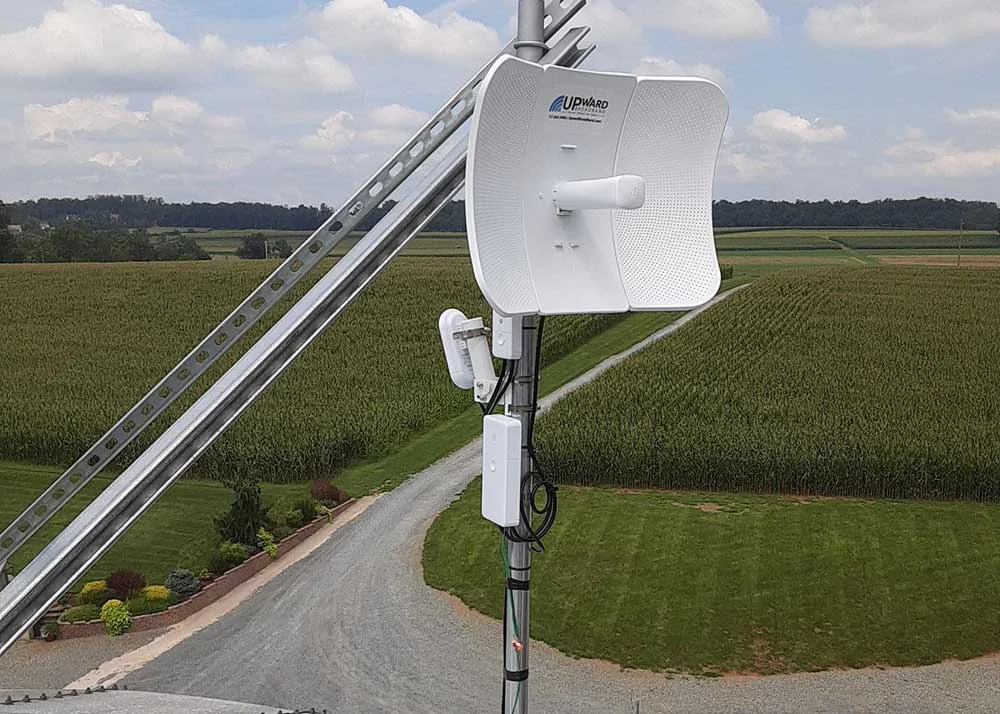
Due to its fixed nature, your signal will be transmitted via radio waves from a tower to a receiver within the tower’s line of sight, which will be affixed to your building. The receiver will then allow for the transmission of your internet connection throughout a limited space.
If you leave that area, you will not be able to access the internet through this connection, even if you’re within range of the tower that is transmitting the signal to your building.
Want a deeper explanation of how it works, needed equipment, and the role of line-of-sight?
Recommended Reading: What Is Fixed Wireless Internet & How Does It Work?
What is the Difference Between Fixed Wireless and Mobile Wireless?
Mobile wireless internet allows transportable devices to be connected to the web as the user moves from location to location through a service provided by a mobile phone provider. Fixed wireless internet is when an internet service provider wirelessly transmits internet to a specific, fixed location, allowing devices within that location to connect to the web.
The difference between fixed wireless broadband and mobile wireless broadband internet comes down to four main factors: portability, latency, bandwidth, and data caps.
Portability
Mobile wireless is a service offered by cell network providers. It’s internet for your cell phones, smartwatches, and other portable devices. You can use it to stream music in your car while driving across the state, read an article while sitting in a waiting room, or share a short video clip to social media while running errands.
Fixed wireless internet, however, is stationary, meaning once you leave your home or business, that connection goes away.
Both fixed wireless and mobile wireless have their place in your daily life. When looking for internet primarily in one place – such as your home – to stream, game, and work, fixed wireless makes sense. Mobile offers you the convenience of internet connection on the go.
Latency
Latency refers to how much time it takes for the internet signal to travel from the source or transmitter to your device and back. If the latency is low, that means information is sent back and forth quicker. If latency is high, there will be a delay between your action and the response.
Fixed wireless internet offers a point-to-point connection, which keeps latency low. Mobile wireless, however, has a much higher latency because it prioritizes portability. Instead of the internet signal being disseminated from one tower to a dedicated receiver at your building, your connection goes from cell tower to cell tower, increasing the distance and time it takes to run information back and forth.
Bandwidth
Bandwidth is the amount of information that can be transmitted from one point to another during a certain amount of time. The higher the bandwidth, the more information that can be shared in a shorter time.
With fixed wireless internet, the same point-to-point connection that keeps latency low helps keep bandwidth high. Only the people in your home or business connected to your internet have access. But with a mobile wireless network, you’re sharing that tower with everyone else in the area who is using the same cell phone provider’s internet.
That’s why mobile broadband performance can dip during busy times (network congestion), especially in areas where many people are on the same tower.
Data Caps
Data caps are limits your internet provider puts on the amount of bandwidth you use in a given billing cycle.
Mobile wireless plans often have data caps that make using them as a primary internet connection difficult or very expensive. While some mobile internet providers may tout unlimited data, they can throttle your connection once you reach a certain limit, slowing down your connection speeds.
Fixed wireless internet is intended to be used as your primary internet service at a home or business, so if there are data caps, they are much higher than a mobile wireless plan.
Some providers have hard limits and going over means overage fees. Others may have no “hard” limit, but they’ll slow down your connection once you’ve exceeded it.
Some, like Upward Broadband, have no limit at all, allowing you unlimited access with no throttling.
Tip: When comparing plans, ask these two questions:
- Is there a data cap (and what happens if I exceed it)?
- Can speeds be throttled during peak usage or after a threshold?
Mobile Hotspot vs Mobile Broadband vs 5G Home Internet – How They Relate
These terms get used interchangeably, but they’re not always the same thing:
- Mobile hotspot: A phone or hotspot device that shares a cellular data connection with other devices nearby (laptops, tablets, etc.).
- Mobile broadband: The broader category of internet delivered over cellular networks (phones, hotspots, and some home internet products).
- 5G home internet: Often delivered over a cellular network but intended for a fixed address. It can be fast, but it may still be affected by coverage, congestion, and plan terms depending on the provider.
If you’re trying to replace home internet, pay extra attention to data policies and consistency during peak hours, not just advertised speeds.
What’s the Difference Between Business Wireless and Home Wireless Internet?
If you’re choosing internet for a business, prioritize consistency, upload performance, and support responsiveness, not just the advertised download speed. Business and home needs can look similar on paper, but they feel different day-to-day.
Business internet typically has the below needs:
- More simultaneous users (staff + devices)
- Better consistency for video calls, cloud apps, and POS tools
- Faster uploads
- Responsive support when something breaks
Home internet is usually optimized for the following:
- Streaming, browsing, smart home devices
- Household Wi-Fi coverage and ease of use
Do You Need Fixed and Mobile Wireless Internet?
Yes, both fixed wireless internet and mobile networks have their place in your daily life.
To sum it up, fixed wireless internet is a great option for replacing your current home or business internet service provider. It offers higher bandwidth and low latency, making it a good choice for activities like online gaming, video streaming, video chatting, and more.
Mobile networks, however, keep you connected on the go for more simple tasks like using mobile apps and surfing the web. Just be sure to keep track of how much data you’re using each month, as overages can be expensive.
Many people opt for both fixed wireless and mobile wireless. Fixed wireless has them covered while they’re at home or work, during which they can do their heavy bandwidth activities. Then, they’ll use their mobile wireless connection through their cell provider to keep their mobile devices connected so they can access whatever they need to whenever they need to.
A simple way to decide:
- Choose fixed wireless if you want a primary connection for a home or business and care about steadier performance.
- Choose mobile wireless if you need portability and internet access while traveling or away from home.
- Choose both if you want the best of both worlds: stability at one address and coverage on the go.
If fast internet with no data caps sounds good to you, you may want to consider switching to fixed wireless internet with Upward Broadband.
Want to learn more about Fixed Wireless Internet? Here’s how it compares to DSL and cable internet service.