Living in a rural area has plenty of benefits, but just like anything, there can be some drawbacks. One of those drawbacks is the lack of options for service providers – in this case, internet providers. Of those few options, DSL is among the most popular service types. DSL is more readily available because it uses existing phone lines to carry data. But is DSL internet good enough for today’s streaming, remote work, and smart home demands?
Another option that is becoming more and more available in rural areas is fixed wireless internet. This type of internet is broadcasted through airwaves from towers to receivers installed on the user’s property, which is typically within 10 miles of the tower. This service is particularly great in areas without the infrastructure to supply high-speed internet.
DSL and fixed wireless internet are very different. This blog will break down both rural internet types to help you select the best option that meets your needs.
What is Fixed Wireless Internet
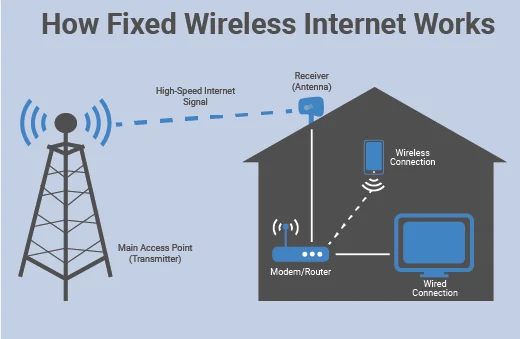
Fixed wireless internet is a high-speed, reliable internet service for rural and underserved areas. Internet is sent from the main access point (typically supplied with high-speed fiber-optic lines) to individual receivers installed at businesses, farms, and homes. Each receiver is typically within 10 miles and has a line of sight with the access point.
Fixed Wireless Internet: Pros and Cons
Advantages of Fixed Wireless Internet:
- Internet is delivered through radio signals. No phone or cable lines required.
- Service is reliable and fast. Speeds are comparable to high-speed cable (typically 25–300+ Mbps).
- There are no data limits.
- No phone service is required with your service – you can cut the cord.
- Fixed wireless internet suppliers are typically locally owned and operated businesses.
Disadvantages of Fixed Wireless Internet
- You must have a line of sight connection with the access point and in most cases, you need to be within 10 miles of the access point. This can limit availability.
- Fixed wireless internet may be more expensive than DSL. The cost is typically in line with cable internet services.
Fixed wireless internet is a good internet option for streaming videos, listening to music, sending large emails, running your business’ credit card machine and other web-based tools.
What is DSL Internet?
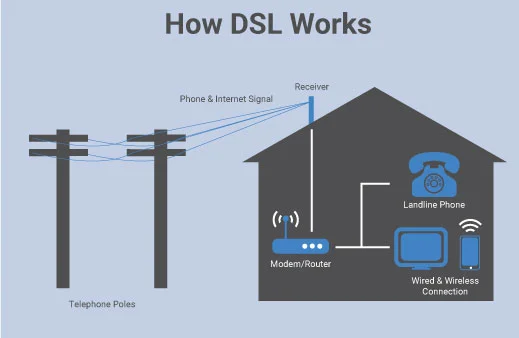
DSL (Digital Subscriber Line) uses phone wires to transmit internet signals. The use of phone lines has allowed DSL to become one of the more readily available internet services. DSL differs from dial-up internet by allowing both internet and phone services to be used at the same time.
DSL Internet: Pros and Cons
Advantages of DSL Internet:
- The cost of DSL is sometimes cheaper than other internet services.
- Newer versions of DSL (like VDSL) can reach up to 100 Mbps, but still fall behind cable and fixed wireless internet.
- There are no new wires needed for service. DSL runs over standard phone lines.
- It’s always on – no need to dial in or wait for services to start up.
Disadvantages of DSL Internet:
- Typically service is provided by the phone company, which means you’ll also likely be required to carry phone service.
- Speeds are dependent on your proximity to the DSL main distribution point. The closer you are the faster your service will be. Your speed will slow down the farther you get from the main distribution point.
- Some DSL providers implement data caps, which can limit heavy streaming or remote work usage.
DSL is a good option for people who are looking for a cost-effective internet service to check e-mail and browse the internet. It’s not a dependable option for streaming videos, listening to music, emailing large files, or running a business.
Fixed Wireless vs DSL: Speed and Performance Compared
One of the biggest differences between fixed wireless and DSL internet comes down to speed and performance. Here’s how they stack up:
| Feature | Fixed Wireless Internet | DSL Internet |
|---|---|---|
| Download Speed | 25–300+ Mbps | 1–100 Mbps |
| Upload Speed | 5–50 Mbps | 1–10 Mbps |
| Latency | 20–50 ms | 25–50 ms |
| Speed Affected by Distance? | Minimal within range | Yes — degrades significantly |
| Data Caps | Typically none | Common with some providers |
| Good for Streaming/Video Calls? | Yes | Depends on plan and distance |
For households that stream video, work from home, or have multiple connected devices, fixed wireless generally provides a more consistent experience. DSL can work well for lighter usage like email, browsing, and occasional streaming, but performance can be unpredictable if you’re far from the provider’s hub.
Not sure how much speed you need? See our guide: What Internet Speed Do I Need?
Is DSL or Fixed Wireless Internet Better?
Which internet service is better? The answer depends on your goals:
- Choose fixed wireless if you need faster speeds, work from home, stream video regularly, or have multiple people and devices online at the same time.
- Choose DSL if your usage is lighter and your home is close to a DSL provider’s central office.
DSL Internet vs Fixed Wireless in South-Central Pennsylvania
For residents in Pennsylvania, the choice between DSL and fixed wireless internet often comes down to what’s actually available at your address. We service many rural communities in areas like Lancaster County, Lebanon County, and Huntingdon County that have limited DSL options. Plus, the DSL service that is available can be slow, especially for homes farther from the provider’s central office.
Fixed wireless internet is expanding rapidly across the region. Upward Broadband currently serves parts of Bedford, Centre, Chester, Cumberland, Dauphin, Franklin, Fulton, Huntingdon, Lancaster, Lebanon, Mifflin, and York Counties.
We are bringing high-speed internet to areas where DSL has been the only option for years. If you live in one of these counties and are frustrated with slow DSL speeds, fixed wireless may be the upgrade you’ve been waiting for.
Upward Broadband provides fast, reliable fixed wireless internet across south-central Pennsylvania. No phone lines, no data caps, and no contracts. If you’re ready to upgrade from DSL, check availability in your area today!
Frequently Asked Questions
Is DSL good internet for Pennsylvania residents?
DSL internet can be adequate for basic tasks like email and web browsing, but it has significant limitations. Speeds typically range from 1–100 Mbps and degrade the farther you are from the provider’s central office. For households that stream video, work remotely, or have multiple connected devices, DSL often falls short compared to fixed wireless or cable internet.
Is fixed wireless internet faster than DSL?
In most cases, yes. Fixed wireless internet typically delivers download speeds of 25–300+ Mbps, while DSL usually tops out around 100 Mbps under ideal conditions.
Does fixed wireless internet have data caps?
At Upward Broadband, we do not impose data caps. You can stream, download, and browse without worrying about overage charges.
Can I get fixed wireless internet in my area?
Fixed wireless internet requires a clear line of sight to a provider’s tower, typically within 10 miles. Availability depends on your location. Upward Broadband currently serves parts of south-central Pennsylvania, including Lancaster, Lebanon, Huntingdon, Chester, York, Cumberland, Dauphin, Bedford, Centre, Franklin, Fulton, and Mifflin Counties. Check our coverage map to see if service is available at your address.
What is the main difference between DSL and fixed wireless internet?
DSL transmits internet signals through copper phone lines, while fixed wireless uses radio signals broadcast from a tower to a receiver on your property. The key practical differences are speed (fixed wireless is generally faster), reliability (DSL degrades with distance), and infrastructure (DSL requires phone lines. Fixed wireless does not).